We are entering the liquidate function with the code below:
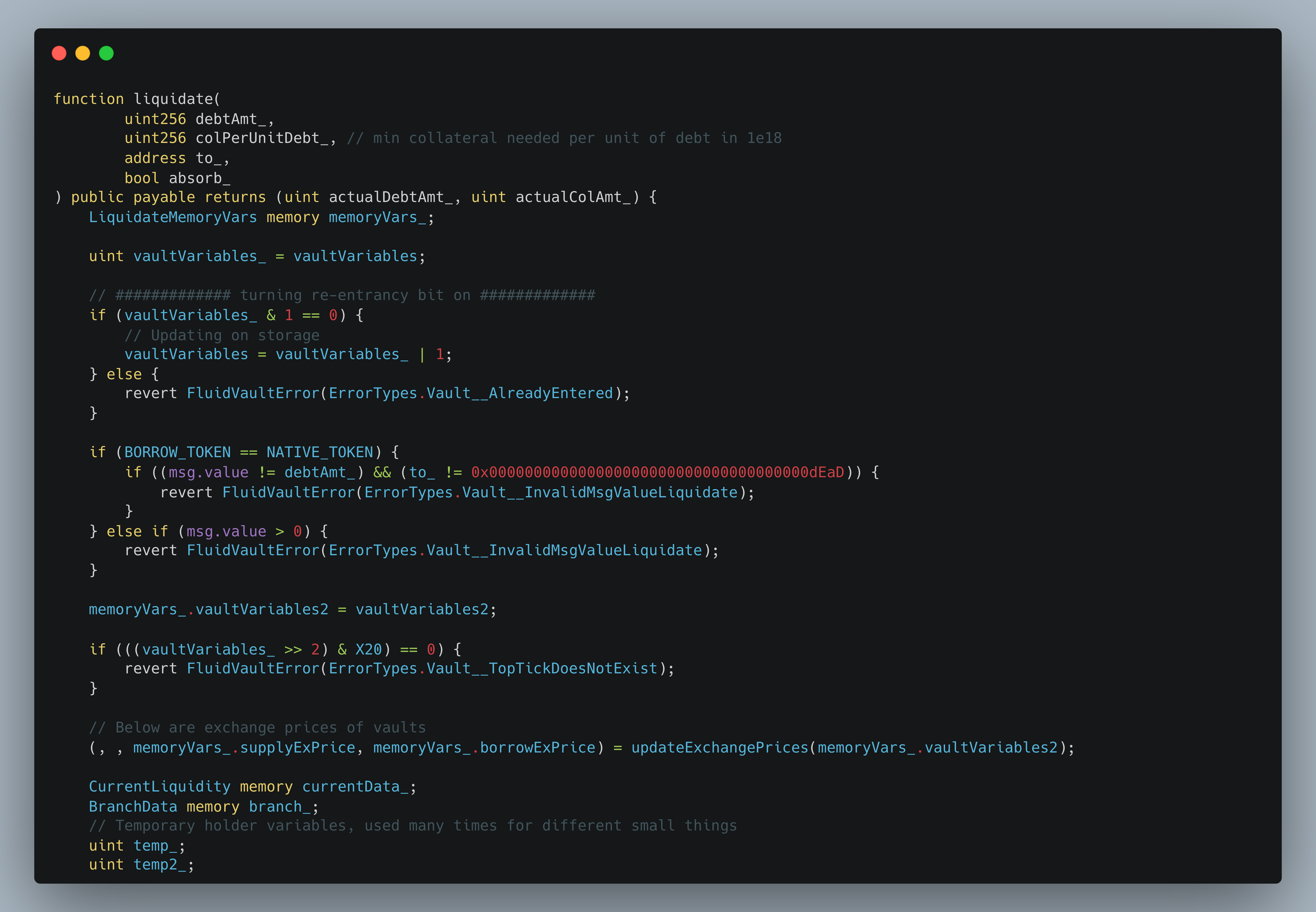
Liquidator is sending:
debtAmt_-> amount of debt to liquidatecolPerUnitDebt_-> min amount of collateral per one unit of debt that liquidator is expecting to get in returnto_-> where to send collateral tokensabsorb_-> whether liquidation should first consume absorbed debt (or better known as bad debt)
Upon entering the function, we first perform the standard reentrancy check:
// ############# turning re-entrancy bit on #############
if (vaultVariables_ & 1 == 0) {
    // Updating on storage
    vaultVariables = vaultVariables_ | 1;
} else {
    revert FluidVaultError(ErrorTypes.Vault__AlreadyEntered);
}
Then we check for msg.value. If the borrow token is native token (e.g. ETH for Ethereum network and L2s), then we ensure that value sent must match the debtAmount param. If not, then no msg.value should be present:
if (BORROW_TOKEN == NATIVE_TOKEN) {
    if ((msg.value != debtAmt_) && (to_ != 0x000000000000000000000000000000000000dEaD)) {
        revert FluidVaultError(ErrorTypes.Vault__InvalidMsgValueLiquidate);
    }
} else if (msg.value > 0) {
    revert FluidVaultError(ErrorTypes.Vault__InvalidMsgValueLiquidate);
}
Dead-address simulation
We are also seeing this hardcoded constant of 0x00..dEaD address, which is a common pattern to deliberately use the main logic function to return internal calculations instead of writing a new separate getter function. In this case, it will later return calculated liquidation amounts:
if (to_ == 0x000000000000000000000000000000000000dEaD) {
    // revert with liquidated amounts if to_ address is the dead address.
    // this can be used in a resolver to find the max liquidatable amounts.
    revert FluidLiquidateResult(actualColAmt_, actualDebtAmt_);
}
Once we check for msg.value, we are checking for the existence of topTick. Without topTick, we can’t run liquidation as we don’t know what the starting point is. This case will rarely ever be triggered, because if there are some users, there will be a top tick:
memoryVars_.vaultVariables2 = vaultVariables2;

if (((vaultVariables_ >> 2) & X20) == 0) {
    revert FluidVaultError(ErrorTypes.Vault__TopTickDoesNotExist);
}
Then we update exchange prices that were already covered here:
// Below are exchange prices of vaults
(, , memoryVars_.supplyExPrice, memoryVars_.borrowExPrice) = updateExchangePrices(memoryVars_.vaultVariables2);
After this, we initialize a bunch of temp memory structs that will be used during liquidation:
struct LiquidateMemoryVars {
    uint256 vaultVariables2;
    int liquidationTick;
    int maxTick;
    uint256 supplyExPrice;
    uint256 borrowExPrice;
}

// note: All the below token amounts are in raw form.
struct CurrentLiquidity {
    uint256 debtRemaining; // Debt remaining to liquidate
    uint256 debt; // Current liquidatable debt before reaching next check point
    uint256 col; // Calculate using debt & ratioCurrent
    uint256 colPerDebt; // How much collateral to liquidate per unit of Debt
    uint256 totalDebtLiq; // Total debt liquidated till now
    uint256 totalColLiq; // Total collateral liquidated till now
    int tick; // Current tick to liquidate
    uint ratio; // Current ratio to liquidate
    uint tickStatus; // if 1 then it's a perfect tick, if 2 that means it's a liquidated tick
    int refTick; // ref tick to liquidate
    uint refRatio; // ratio at ref tick
    uint refTickStatus; // if 1 then it's a perfect tick, if 2 that means it's a liquidated tick, if 3 that means it's a liquidation threshold
}

struct BranchData {
    uint id;
    uint data;
    uint ratio;
    uint debtFactor;
    int minimaTick;
    uint baseBranchData;
}