General introduction
On the previous page, we mentioned the concept of maxTick, but let’s give one example.
Suppose we have the following setup:
Vault = ETH / USDC

CF                    = 80%
Liquidation Threshold = 85%
Liquidation Max Limit = 90%
Liquidation Penalty   = 5%

1 ETH = 2500 USDC

- In this example, with regular actions on the protocol level, the user can borrow max 80% of value.
- If collateral price starts dropping down, there will be some buffer of 5%, so the user has time to adjust his position before he enters the liquidation zone.
- Liquidation zone will be run in range 85 - 90, where regular incentive with bonus is applied.
- If, however, the user gets above 90%, we are entering the absorb zone where regular liquidation incentive is not applied.
Suppose we have position:
Before liquidation
-------------------
collateral value: 1020$
debt value: 900$
ltv = 88.23%
As we are in the liquidation zone with 5% bonus, for 100 $ USDC debt repaid, the liquidator will get 105 $ worth of ETH collateral.
After liquidation
------------------
collateral value: 915$
debt value: 800$
ltv = 87.43%
Although still in the liquidation zone, the position is healthier than before (87.43% < 88.23%).
Now suppose that starting position is this:
Before liquidation
-------------------
collateral value: 1000$
debt value: 960$
ltv = 96%
This position is part of the absorb zone, but let’s naively try to apply the bonus factor:
After liquidation
------------------
collateral value: 895$
debt value: 860$
ltv = 96.08%
96.08% > 96%, we made the position even more risky!!!
This is the exact reason why we can’t use normal liquidation rules for highly risky positions, hence why Fluid introduces the absorb zone.
Implementation introduction
Let’s go back to the main liquidation logic. This is the snippet of code we are looking at:
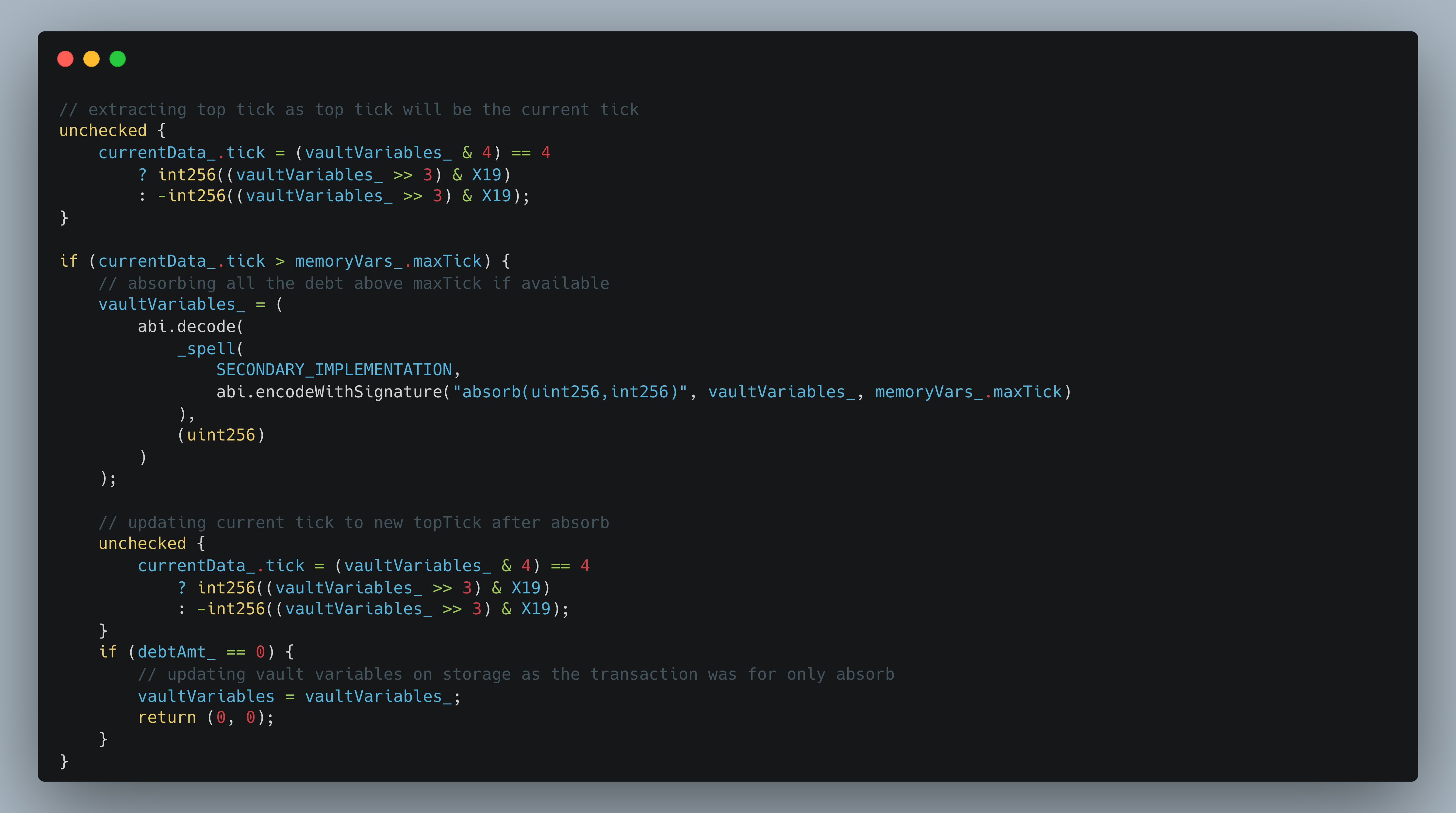
We are first loading current topTick from vault:
// extracting top tick as top tick will be the current tick
unchecked {
    currentData_.tick = (vaultVariables_ & 4) == 4
        ? int256((vaultVariables_ >> 3) & X19)
        : -int256((vaultVariables_ >> 3) & X19);
}
Then we compare it against maxTick to check if we need to run absorb flow:
if (currentData_.tick > memoryVars_.maxTick) ...
As we are analyzing absorb flow, we will assume that topTick is indeed in the absorb zone above maxTick. So upon entering this function, we see the following call:
vaultVariables_ = (
    abi.decode(
        _spell(
            SECONDARY_IMPLEMENTATION,
            abi.encodeWithSignature("absorb(uint256,int256)", vaultVariables_, memoryVars_.maxTick)
        ),
        (uint256)
    )
);
We will go back to this soon, but what I want you to see here is that we are not passing standard liquidation function params like debt or colPerUnitDebt, meaning this absorb flow will be some generalized logic to clean up positions.
We also see that we expect this function to give us new vaultVariables with new topTick, which we can update in the current function:
// updating current tick to new topTick after absorb
unchecked {
    currentData_.tick = (vaultVariables_ & 4) == 4
        ? int256((vaultVariables_ >> 3) & X19)
        : -int256((vaultVariables_ >> 3) & X19);
}
After this, we check if the liquidator passed 0 as debtAmt_, which will mean that he only wanted to run absorb flow without real liquidations later. In this case, we just update vault variables in storage and return:
if (debtAmt_ == 0) {
    // updating vault variables on storage as the transaction was for only absorb
    vaultVariables = vaultVariables_;
    return (0, 0);
}
Now going back to the main absorb function.
We already mentioned at the start of the vault protocol section that there will be 2 main methods on vault that we already touched (operate, liquidate) and 1 other (absorb). This other method is part of secondary implementation, that’s being delegatecalled to with the spell method:
function _spell(address target_, bytes memory data_) private returns (bytes memory response_) {
    assembly {
        let succeeded := delegatecall(gas(), target_, add(data_, 0x20), mload(data_), 0, 0)
        let size := returndatasize()

        response_ := mload(0x40)
        mstore(0x40, add(response_, and(add(add(size, 0x20), 0x1f), not(0x1f))))
        mstore(response_, size)
        returndatacopy(add(response_, 0x20), 0, size)

        switch iszero(succeeded)
        case 1 {
            // throw if delegatecall failed
            returndatacopy(0x00, 0x00, size)
            revert(0x00, size)
        }
    }
}
This only exists to reduce bytecode size of the vault implementation, which is not an uncommon thing to do in DeFi protocols (Compound V3 does the same thing with CometExt: https://github.com/compound-finance/comet/blob/main/contracts/CometExt.sol).
Both implementation contracts will follow the same storage layout (extending the Variables contract), so for us there is no difference in analysis, and we can jump straight to implementation.