Finally, we are arriving at the core liquidation loop that will be the heart of this vault liquidate function.

As seen on the image above, we can divide this function into different logical parts which we will analyze separately:
- Setup of local vars
- Calculation of current tick ratio
- Addition of new debt and collateral for liquidation
- Update of
tickHasDebtand next active tick search - Finding the reference tick
- Finding the reference ratio
- Calculation of debt and collateral to liquidate
- Finish of liquidation loop
- Updating amounts and factors for next iteration
- Merging branches
- Updating tick and ratio for next iteration
Setup of local vars
uint debtLiquidated_;
uint colLiquidated_;
uint debtFactor_ = BigMathVault.TWO_POWER_64;

TickHasDebt memory tickHasDebt_;
unchecked {
    tickHasDebt_.mapId = (currentData_.tick < 0)
        ? (((currentData_.tick + 1) / 256) - 1)
        : (currentData_.tick / 256);
}
We start slowly by setting a few local variables that will be used later. Then we find the mapId of the tickHasDebt mapping for current topTick.
Calculation of current tick ratio
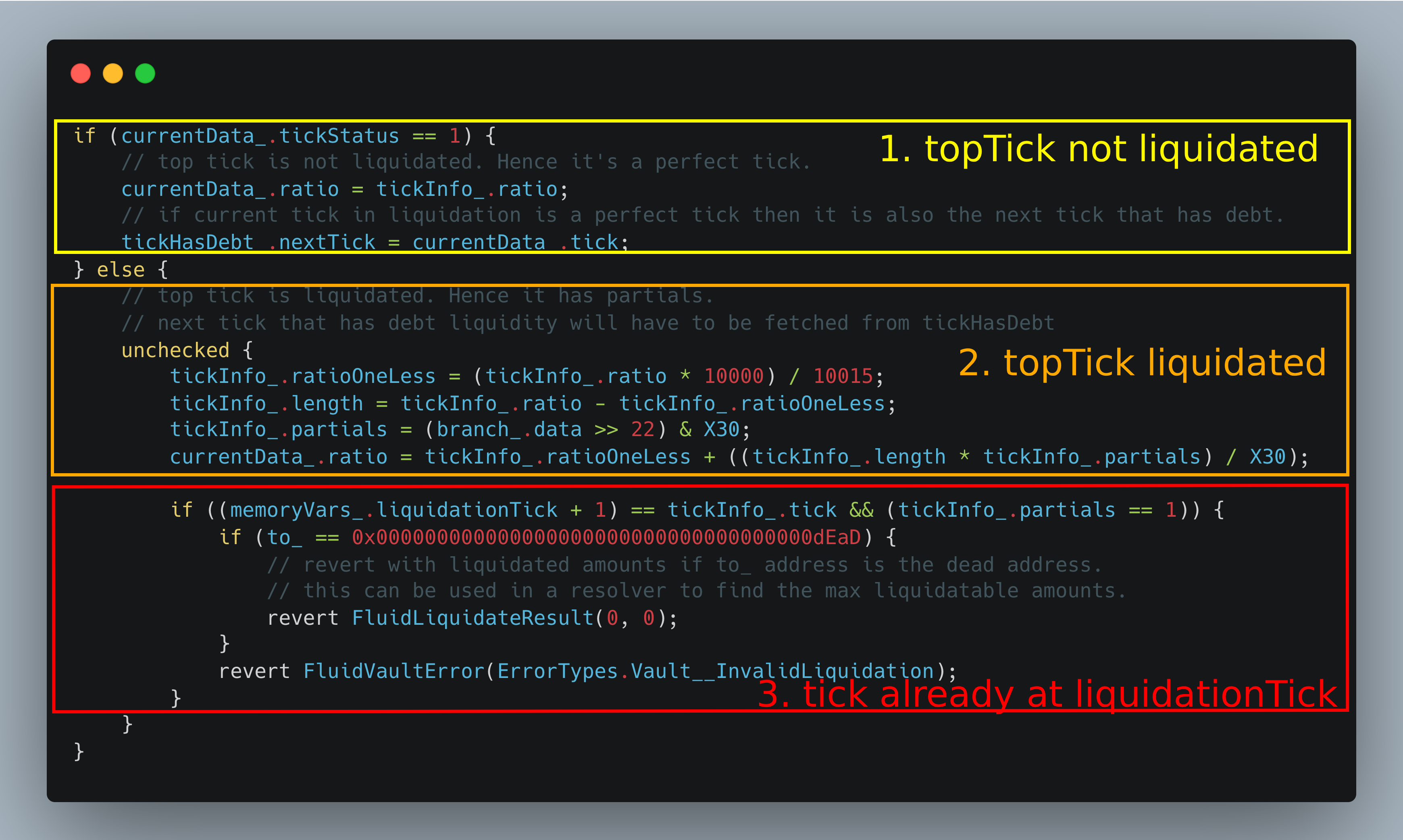
Current topTick from which we are starting the liquidation can either be liquidated or not.
If it is not liquidated, then we know it is a perfect tick (no partial) with some debt, so we can read the ratio directly. We also set nextTick to current tick, which will be used later.
If it is liquidated, then topTick is also minimaTick, and it will have some partial which we need to use in order to calculate the exact ratio.
Now there is one interesting case left, labeled at point 3 on the image above. In order to understand this check, we will cheat a bit, and jump to future code where we end liquidation at liquidation threshold.
// End in liquidation threshold.
// finalRatio_ = currentData_.refRatio;
// Increasing liquidation threshold tick by 1 partial. With 1 partial it'll reach to the next tick.
// Ratio change will be negligible. Doing this as liquidation threshold tick can also be a perfect non-liquidated tick.
unchecked {
    tickInfo_.tick = currentData_.refTick + 1;
}
// Making partial as 1 so it doesn't stay perfect tick
tickInfo_.partials = 1;
// length is not needed as only partials are written to storage
When Fluid ends liquidation exactly at liquidation threshold, we don’t want that liquidation tick to be a perfect tick.
Why?
Because there could also exist the same valid perfect tick with debt, so we would have a harder time picking the next tick in the liquidation loop.
So to avoid that, if we landed at perfect tick X as liquidation tick, we will deliberately set it to X+1 and give it a partial of 1. This way we know that liquidation tick will never match a perfect tick.
That’s good, but then we also need to handle that case later.
That’s what we are doing with this check:
if ((memoryVars_.liquidationTick + 1) == tickInfo_.tick && (tickInfo_.partials == 1)) revert ...
So when we are calculating the tick where we want to start liquidation, we don’t want that tick to be liquidationTick, as that would mean we don’t have any meaningful debt to liquidate in between.
Addition of new debt and collateral for liquidation
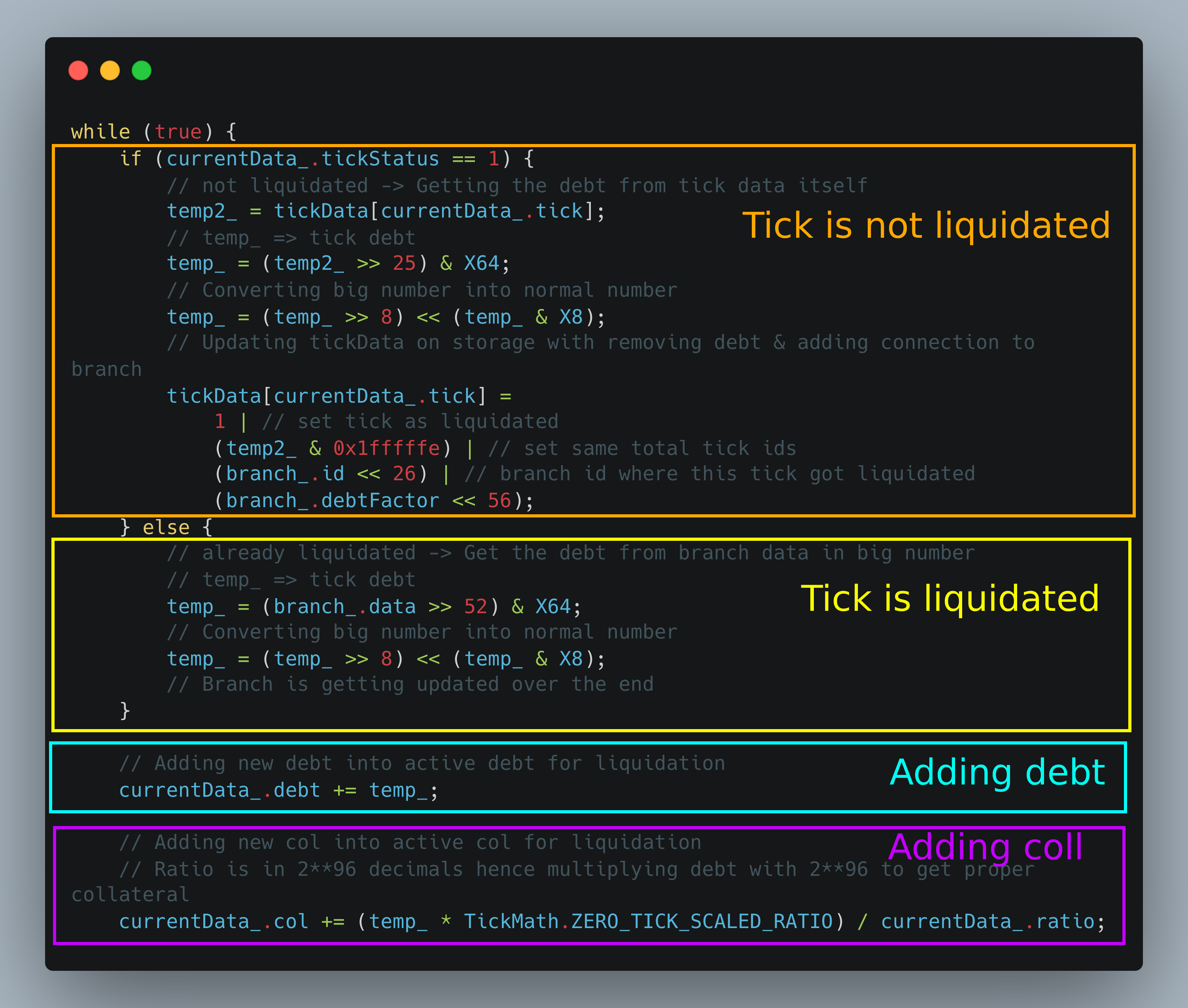
We are entering the liquidation loop now!
The first thing we do is ask whether current tick is liquidated or not.
Tick is not liquidated
If the tick is not liquidated, we know that debt will live in the latest generation in the tickData mapping.
So we extract the debt and mark the tick as liquidated. If you remember from before, we actually already touched this exact part of code when we were running liquidation loops manually.
As soon as we touch the latest generation of tickData in the liquidation loop, we want to mark it as liquidated and store the current branch and debt factor.
tickData[currentData_.tick] =
    1 | // set tick as liquidated
    (temp2_ & 0x1fffffe) | // set same total tick ids
    (branch_.id << 26) | // branch id where this tick got liquidated
    (branch_.debtFactor << 56);
Tick is liquidated
If the tick is liquidated, debt will live in the branch itself, so we just read the debt from the branch:
temp_ = (branch_.data >> 52) & X64;
// Converting big number into normal number
temp_ = (temp_ >> 8) << (temp_ & X8);
Adding debt
currentData_.debt will be the variable to store all debt in consideration to be liquidated. So at any moment, we can’t liquidate more than this variable.
In this case, we are adding new debt for the first time in the first liquidation loop:
// Adding new debt into active debt for liquidation
currentData_.debt += temp_;
Adding collateral
The same way, currentData_.col variable will hold active collateral for liquidation.
Here, we update it for the first time by calculating it from debt and ratio:
// Adding new col into active col for liquidation
// Ratio is in 2**96 decimals hence multiplying debt with 2**96 to get proper collateral
currentData_.col += (temp_ * TickMath.ZERO_TICK_SCALED_RATIO) / currentData_.ratio;
Update of tickHasDebt and next active tick search
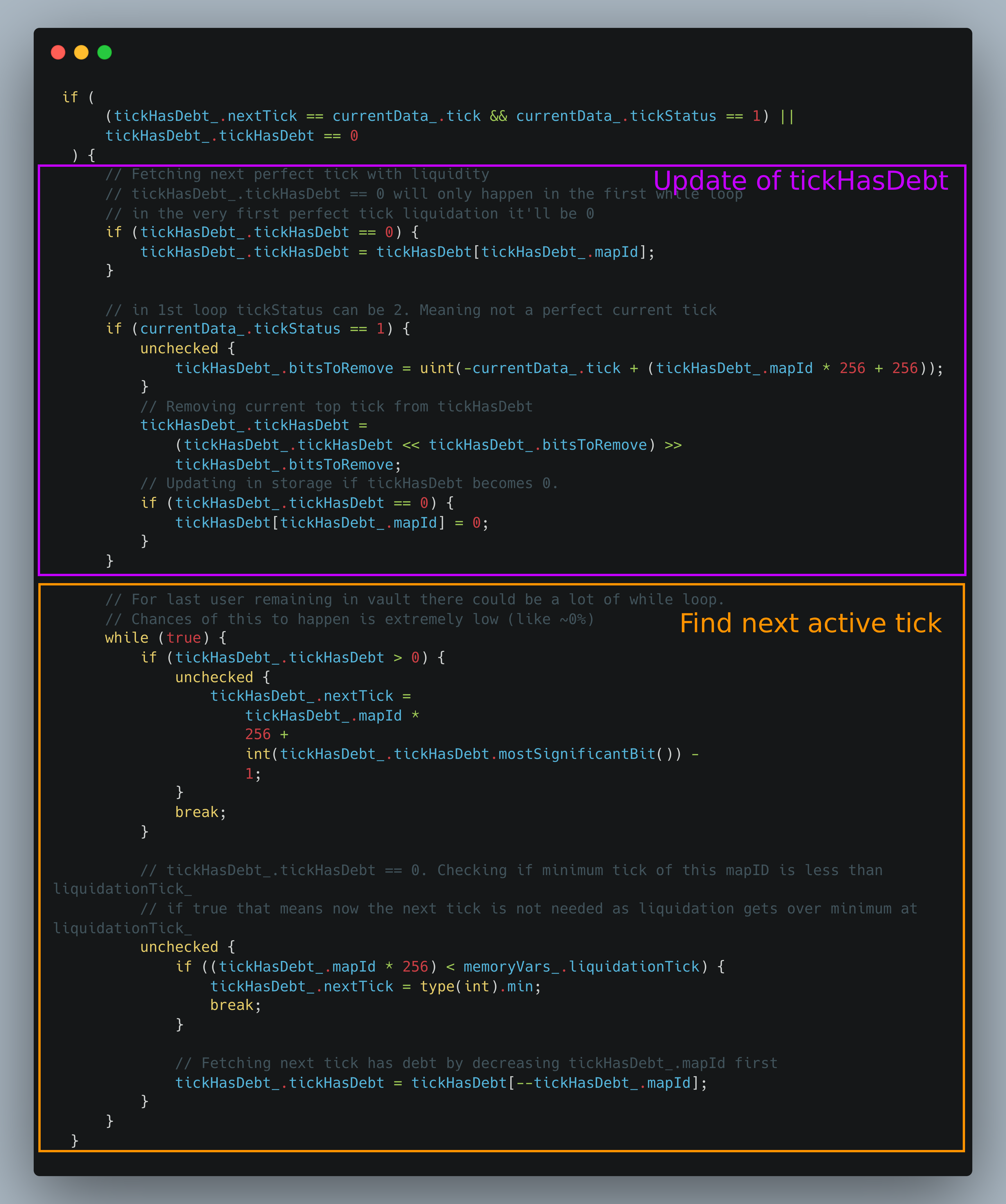
The primary purpose of this block is to update the tickHasDebt mapping for current tick and to give us the next active tick.
It runs in 2 cases:
tickHasDebtis empty, meaning we need to fetch the next non-zero 256-bit index- current tick is active tick, which means we need to remove it from the
tickHasDebtmapping as it is getting liquidated
If empty, we start by fetching tickHasDebtIndex:
if (tickHasDebt_.tickHasDebt == 0) {
    tickHasDebt_.tickHasDebt = tickHasDebt[tickHasDebt_.mapId];
}
Then, if current tick is not already liquidated, we remove it from the tickHasDebt mapping by locating the exact bit to clear in the bitmap index:
if (currentData_.tickStatus == 1) {
    unchecked {
        tickHasDebt_.bitsToRemove = uint(-currentData_.tick + (tickHasDebt_.mapId * 256 + 256));
    }
    // Removing current top tick from tickHasDebt
    tickHasDebt_.tickHasDebt =
        (tickHasDebt_.tickHasDebt << tickHasDebt_.bitsToRemove) >>
        tickHasDebt_.bitsToRemove;
    // Updating in storage if tickHasDebt becomes 0.
    if (tickHasDebt_.tickHasDebt == 0) {
        tickHasDebt[tickHasDebt_.mapId] = 0;
    }
}
In both cases, the next step will be to find the next active tick. The reason we need this is because every liquidation loop will try to find the next highest tick as liquidation point. That highest liquidation point can be either some active tick in tickHasDebt, minima, or liquidation tick. So when comparing options we are about to see in a moment, we need to know what is the next highest active tick from the tickHasDebt mapping.
The while loop just iterates over bitmap and it either breaks when we find the next active tick:
if (tickHasDebt_.tickHasDebt > 0) {
    unchecked {
        tickHasDebt_.nextTick =
            tickHasDebt_.mapId *
            256 +
            int(tickHasDebt_.tickHasDebt.mostSignificantBit()) -
            1;
    }
    break;
}
or when the next active tick is below liquidation tick, in which case we can assign it to minimum value as we know this tick won’t be liquidated in this loop nor it will be a valid next liquidation point:
if ((tickHasDebt_.mapId * 256) < memoryVars_.liquidationTick) {
    tickHasDebt_.nextTick = type(int).min;
    break;
}
Finding the reference tick
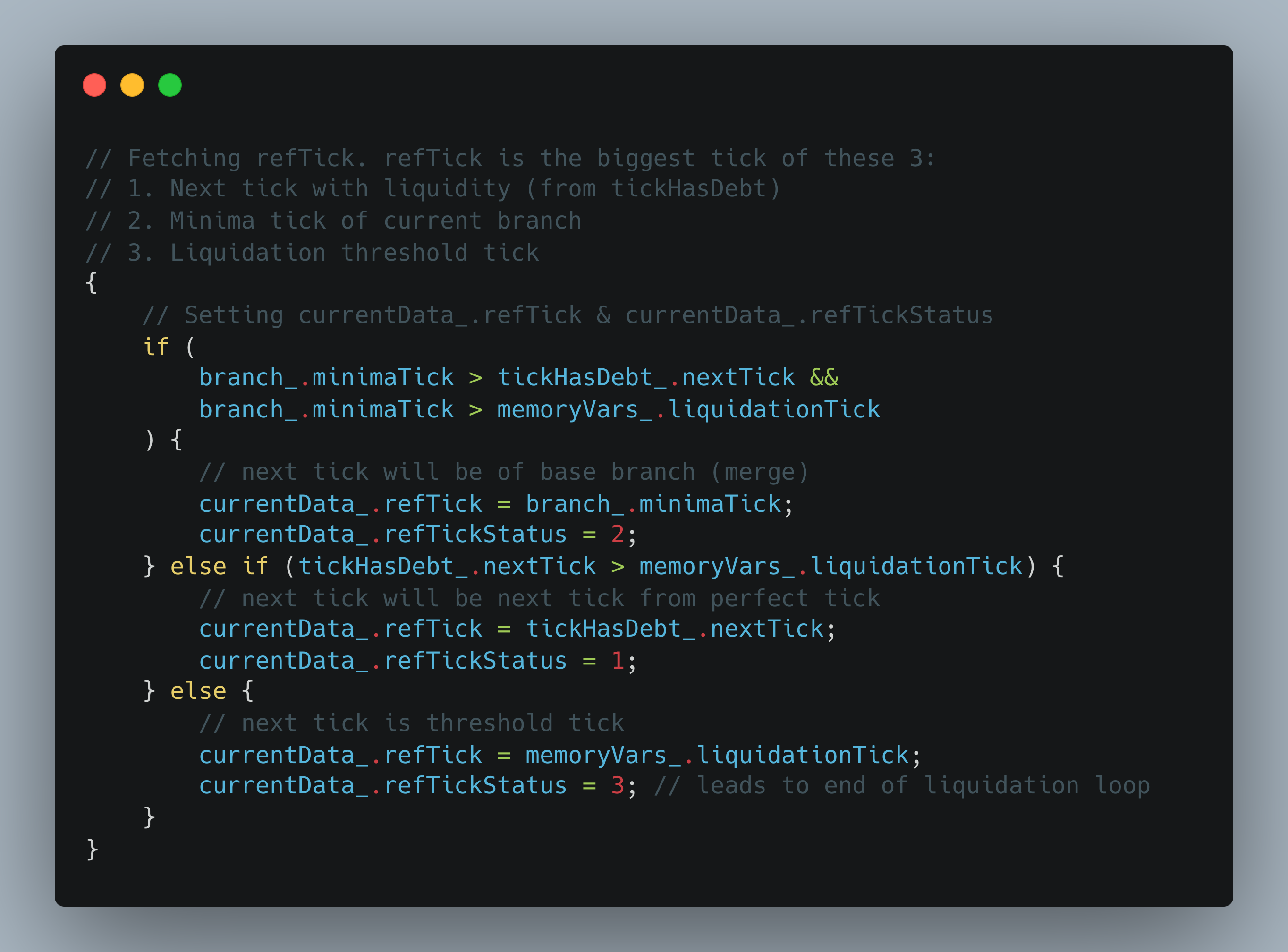
If you recall from liquidations and factors page, every liquidation iteration needs to know how much debt should be liquidated in the current iteration so that after debt / collateral composition moves to the next liquidation point.
That next liquidation point is called reference tick and can be 1 of 3 values:
- Next active tick from
tickHasDebtmapping - Base branch minima tick
- Liquidation tick
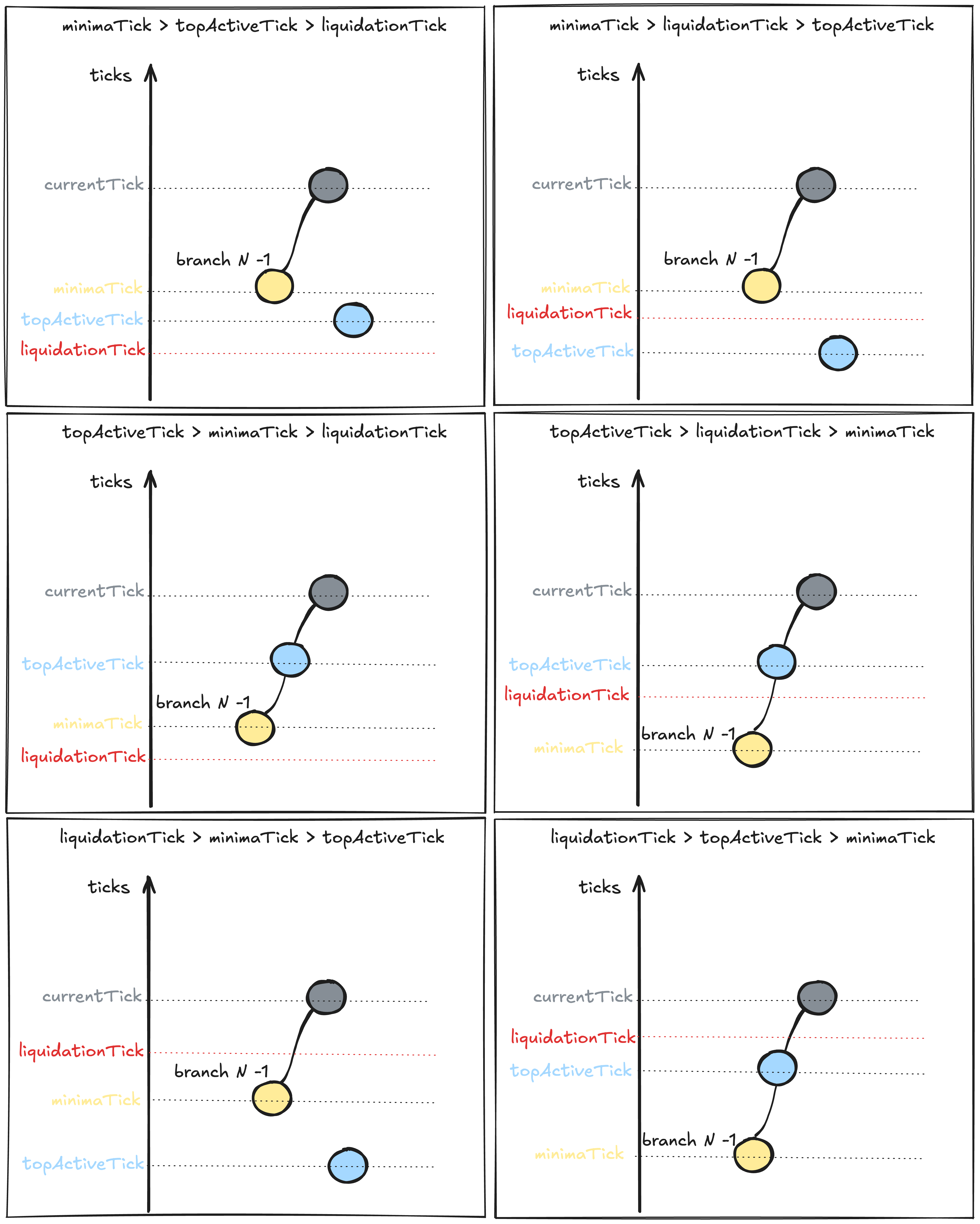
The code above finds the max of these 3 values and sets the refTickStatus so we can differentiate between these 3 cases.
Note that comparisons are strict greater-than, meaning if we end at liquidation tick equal to active tick or minima, we will use liquidation tick and finish the liquidation loop.
So at a high level, at every iteration we have these 6 possible scenarios (without equal cases) for how these 3 points can be arranged:
Finding the reference ratio
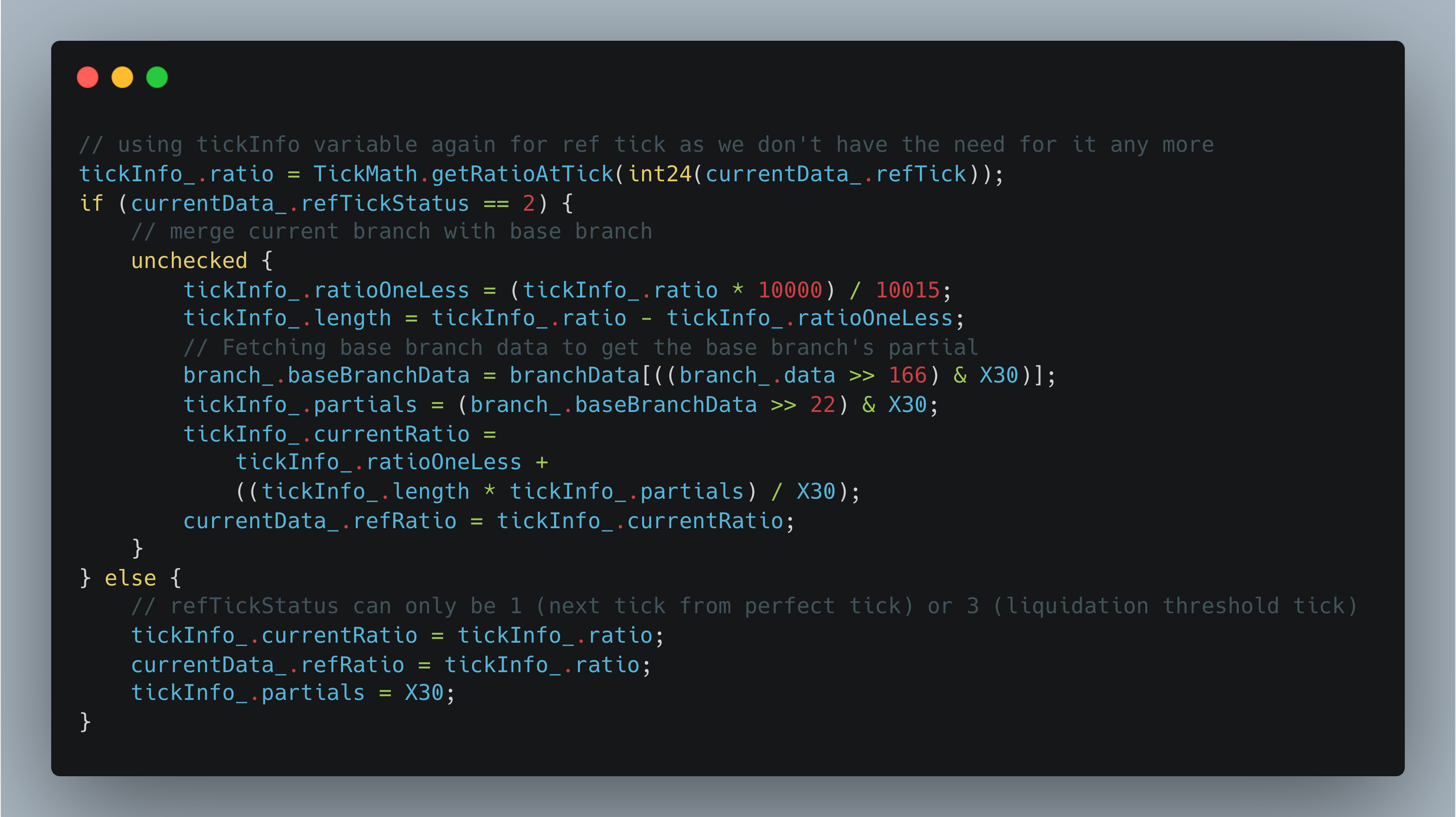
Once we have reference tick, we need to calculate reference ratio.
This code above just reads the ratio from TickMath.getRatioAtTick and applies the partial if reference tick is minima.
Calculation of debt and collateral to liquidate
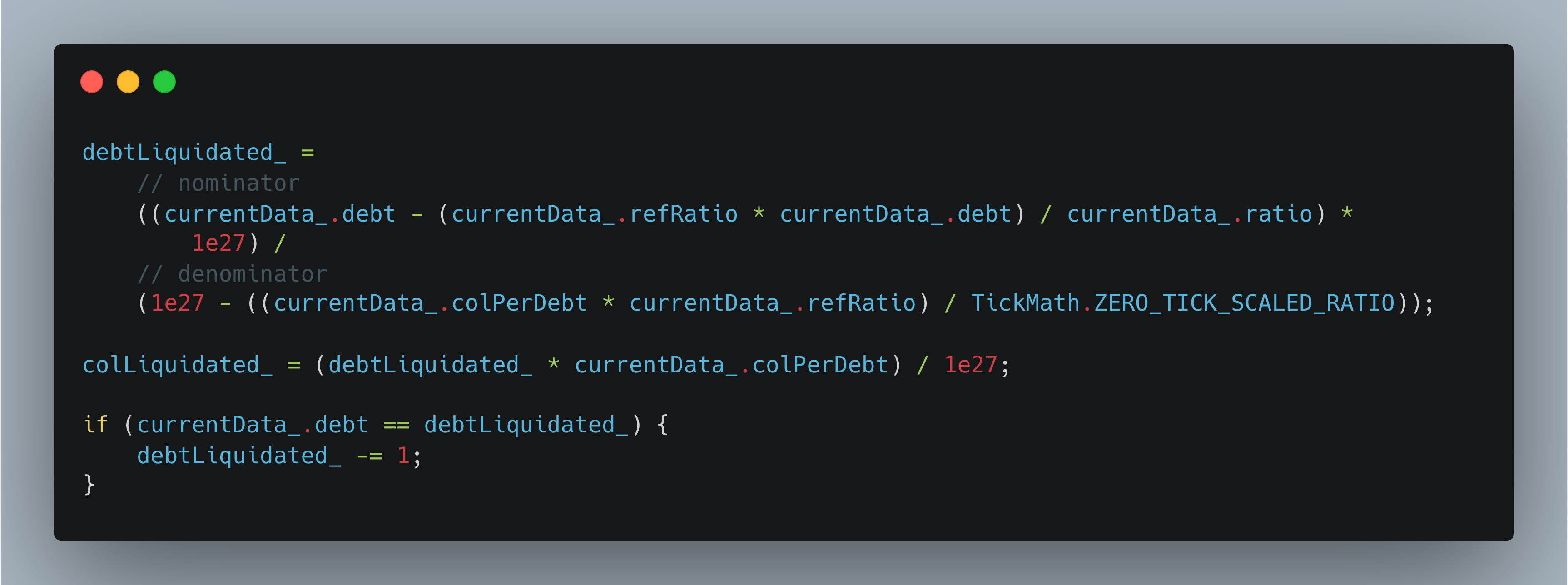
We are starting from some tick with some debt and we want to liquidate just enough debt so that final ratio ends at that reference ratio.
This is the formula, as stated in comments:
(debt - x) / (coll - x * collPerDebt) = refRatio
Multiply by (coll - x * collPerDebt) on both sides:
(debt - x) = refRatio * (coll - x * collPerDebt)
(debt - x) = refRatio * coll - refRatio * x * collPerDebt
Move x to one side:
refRatio * x * collPerDebt - x = refRatio * coll - debt
Factor out:
x * (refRatio * collPerDebt - 1) = refRatio * coll - debt
Get x:
     refRatio * coll - debt
x = ----------------------------
     refRatio * collPerDebt - 1
Both numerator and denominator are negative, which is quite well explained in comments:
Note
“Calculation results of numerator & denominator is always negative which will cancel out to give positive output in the end so we can safely cast to uint.
for nominator:
ratioStart can only be >= ratioEnd, so first part can only be reducingcurrentData_.debt, leading tocurrentData_.debt reduced - currentData_.debt original * 1e27-> can only be a negative number.for denominator:
currentData_.colPerDebtandcurrentData_.refRatioare inversely proportional to each other.
The maximum value they can ever be is ~9.97e26, which is 0.3% away from 100%, because liquidation threshold + liquidation penalty can never be > 99.7%.
This can also be verified by going back from min / max ratio values further up where we fetch oracle price etc.As optimization, we can inverse nominator and denominator subtraction to directly get a positive number.”
So we can multiply by -1 and get:
       debt - refRatio * coll
x = ---------------------------
     1 - refRatio * collPerDebt
We know that coll is starting collateral that can be substituted with: debt / ratioStart:
       debt - (refRatio * debt / ratioStart)
x = -----------------------------------------
            1 - refRatio * collPerDebt
We can then multiply both sides with 1e27:
       1e27 * (debt - (refRatio * debt / ratioStart))
x = ---------------------------------------------------
            1e27 * (1 - refRatio * collPerDebt)
Now if we just expand denominator:
1e27 * (1 - refRatio * collPerDebt) = 1e27 - 1e27 * refRatio * collPerDebt
We know from before that collPerDebt is stored in 1e27 decimals and refRatio is stored in Q96 representation, so we get:
1e27 - 1e27 * refRatio / Q96 * collPerDebt / 1e27
=
1e27 - collPerDebt * refRatio / Q96
Substituting this to final x:
       (debt - (refRatio * debt / ratioStart))  * 1e27
x = ---------------------------------------------------
            1e27 - collPerDebt * refRatio / Q96
which matches exactly Solidity code above.
Note that once we know debt to liquidate, getting collateral to liquidate is straightforward:
colLiquidated_ = (debtLiquidated_ * currentData_.colPerDebt) / 1e27;
Note that there is one more subtle implementation detail left:
if (currentData_.debt == debtLiquidated_) {
    debtLiquidated_ -= 1;
}
This just prevents rounding issues and ensures that all future calculations do not push debt to zero.
A few of such calculations that we will see later:
- Final ratio calc:
 temp_ =
    ((currentData_.debt - debtLiquidated_) * TickMath.ZERO_TICK_SCALED_RATIO) /
    (currentData_.col - colLiquidated_);
- Debt factor calc:
debtFactor_ = (debtFactor_ * (currentData_.debt - debtLiquidated_)) / currentData_.debt;
Updating amounts and factors for next iteration
Let’s say we don’t want to finish liquidation just yet, so after we calculate debt to liquidate, we need to update data for the next iteration.
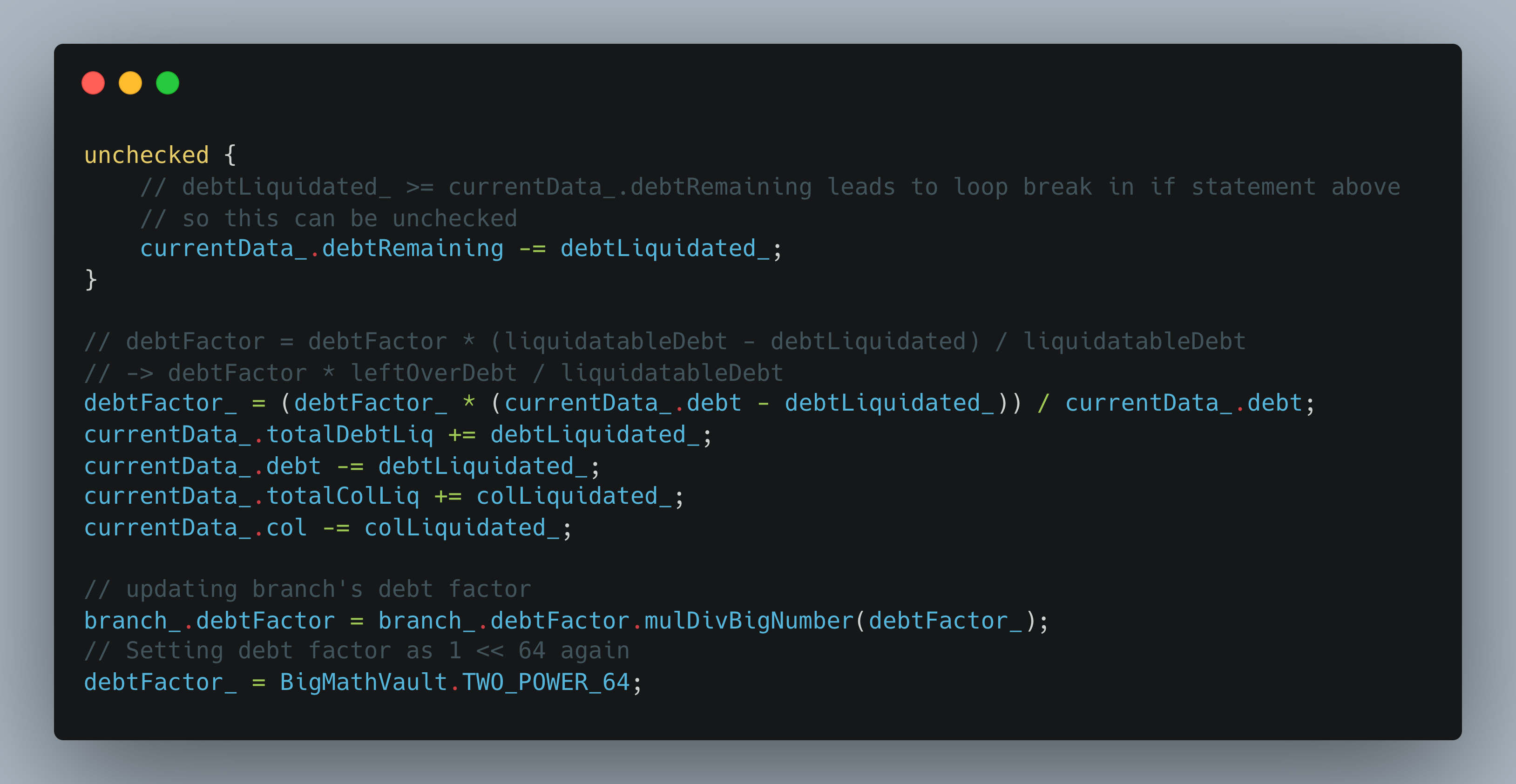
We first start by subtracting debt liquidated from liquidator remaining debt to liquidate.
currentData_.debtRemaining -= debtLiquidated_;
Then we update debt factor and branch debt factor which we already covered here:
debtFactor_ = (debtFactor_ * (currentData_.debt - debtLiquidated_)) / currentData_.debt;
branch_.debtFactor = branch_.debtFactor.mulDivBigNumber(debtFactor_);
Reminder
Every branch will start with debt factor of 1, and every iteration will:
- lower that debt factor depending on the debt liquidated
- store the new branch debt factor for next iteration
This way, whenever we touch some tick, we immediately store the debt factor of current branch, which would represent the point when the tick got introduced in the liquidation loop.
After liquidation finishes, the branch will have final end debt factor.
Retrieving the user positions later will use starting debt factor from
tickDataand final branch debt factor.
Besides calculating factors, we update internal accounting variables that will tell us how much is liquidated so far and with how much debt and collateral we enter into the next liquidation loop:
currentData_.totalDebtLiq += debtLiquidated_;
currentData_.debt -= debtLiquidated_;
currentData_.totalColLiq += colLiquidated_;
currentData_.col -= colLiquidated_;
Merging branches
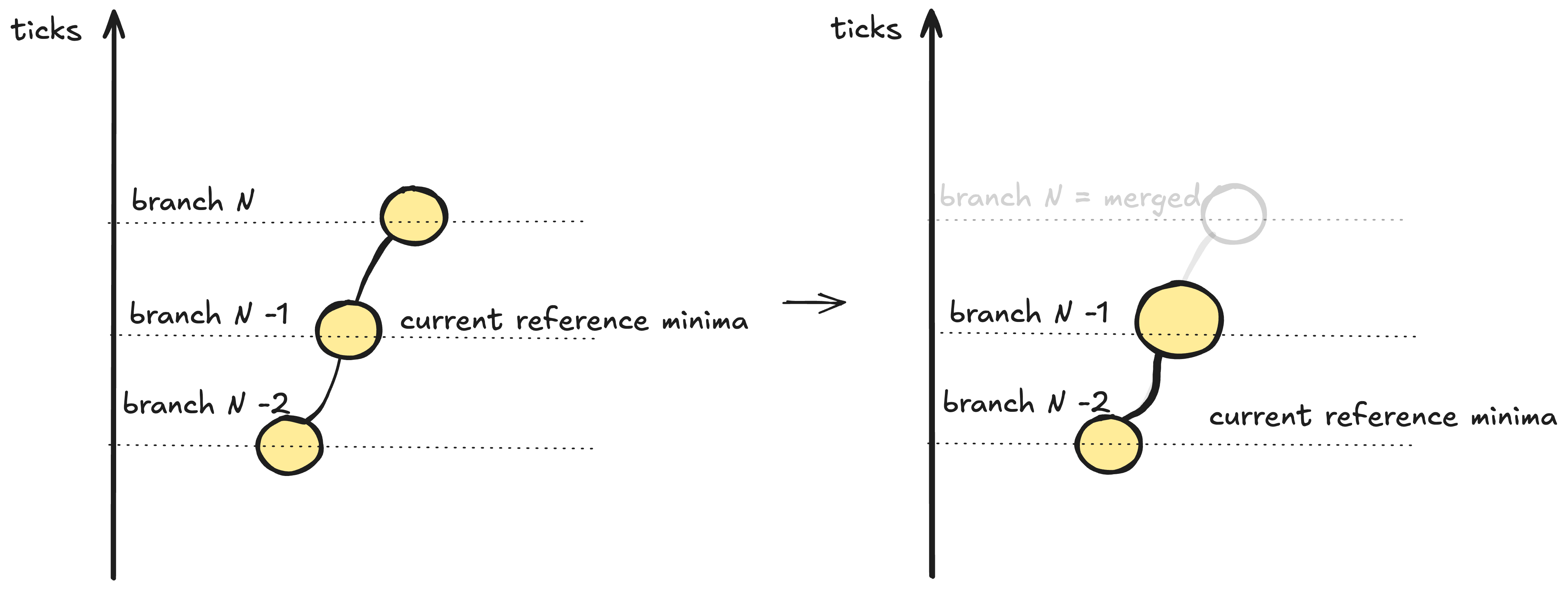
If our next reference tick happens to be base branch minima tick, we hit merge event.
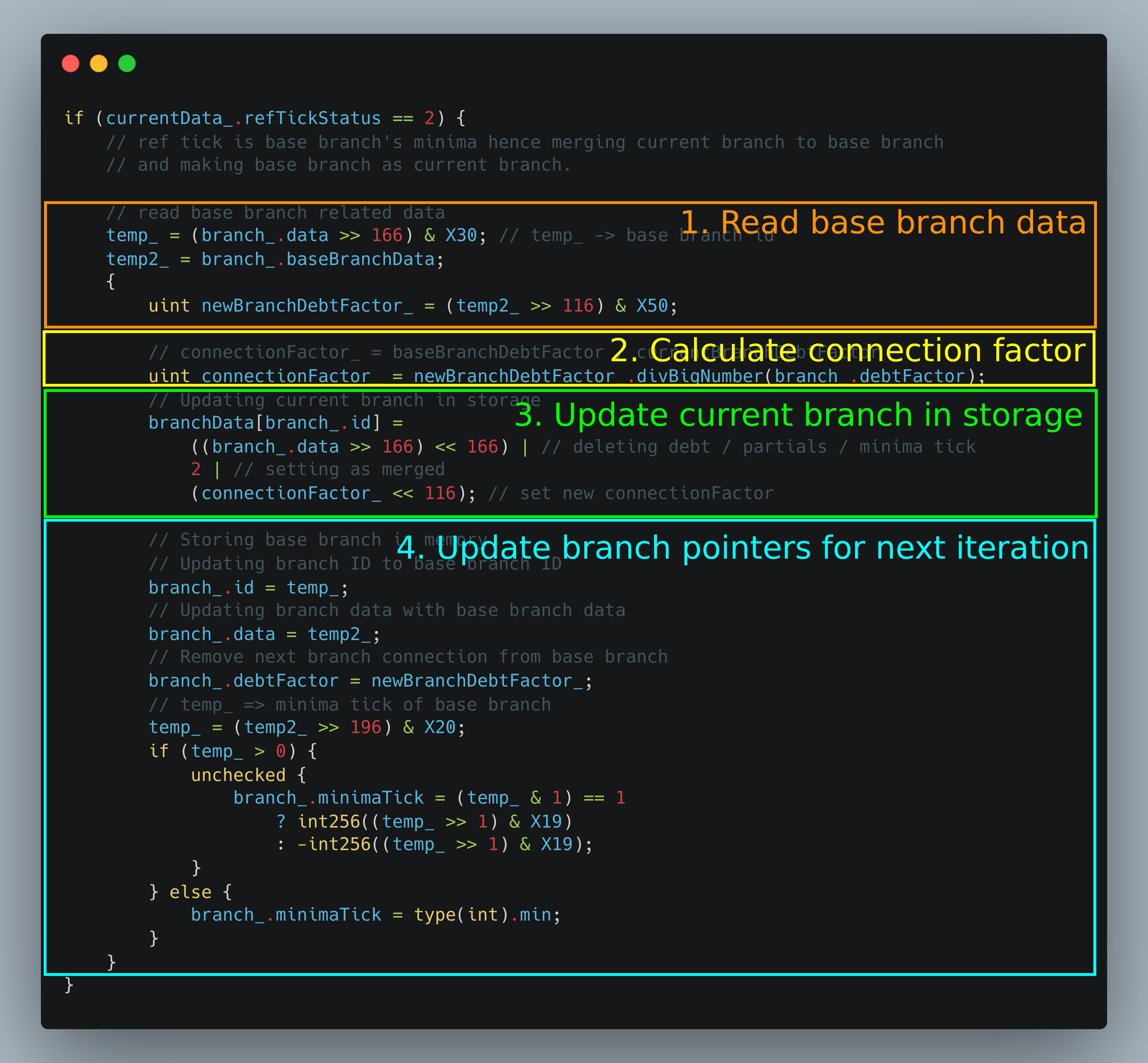
- We first read base branch data along with base branch debt factor.
- After that we calculate connection factor as:
connectionFactor = baseBranchDebtFactor / currentBranchDebtFactor
- Then we update current branch data in storage.
branchData[branch_.id] =
    ((branch_.data >> 166) << 166) | // deleting debt / partials / minima tick
    2 | // setting as merged
    (connectionFactor_ << 116); // set new connectionFactor
Notice that we mark the branch as merged, and we delete the previous debt/partials and minima.
The reason we need to delete the debt is because we previously added it to active debt for liquidation, so it’s no longer part of this branch. Also, the minima with partials loses its purpose once the branch gets merged, because the only minima important from that moment is the minima from the base branch this current branch gets merged into.
The most important thing to store will be connectionFactor, as it will allow us to safely move all positions from current branch to base branch and not lose info of who got liquidated and how much on the previous branch.
- The fourth step would be to update the branch pointer for next iteration:
- we set the base branch as new active branch for next liquidation. Let’s call this new branch
B - we update the new minima to be the minima of base branch of
B.
Updating tick and ratio for next iteration
// Making refTick as currentTick
currentData_.tick = currentData_.refTick;
currentData_.tickStatus = currentData_.refTickStatus;
currentData_.ratio = currentData_.refRatio;
For the next iteration, all that’s left to do is mark the refTick as the current new tick. This means that in the next iteration, new refTick will be calculated from previous refTick and that’s how loop iterates.
Finish of liquidation loop
The only thing left to analyze in this liquidation loop is what happens when we finish it.
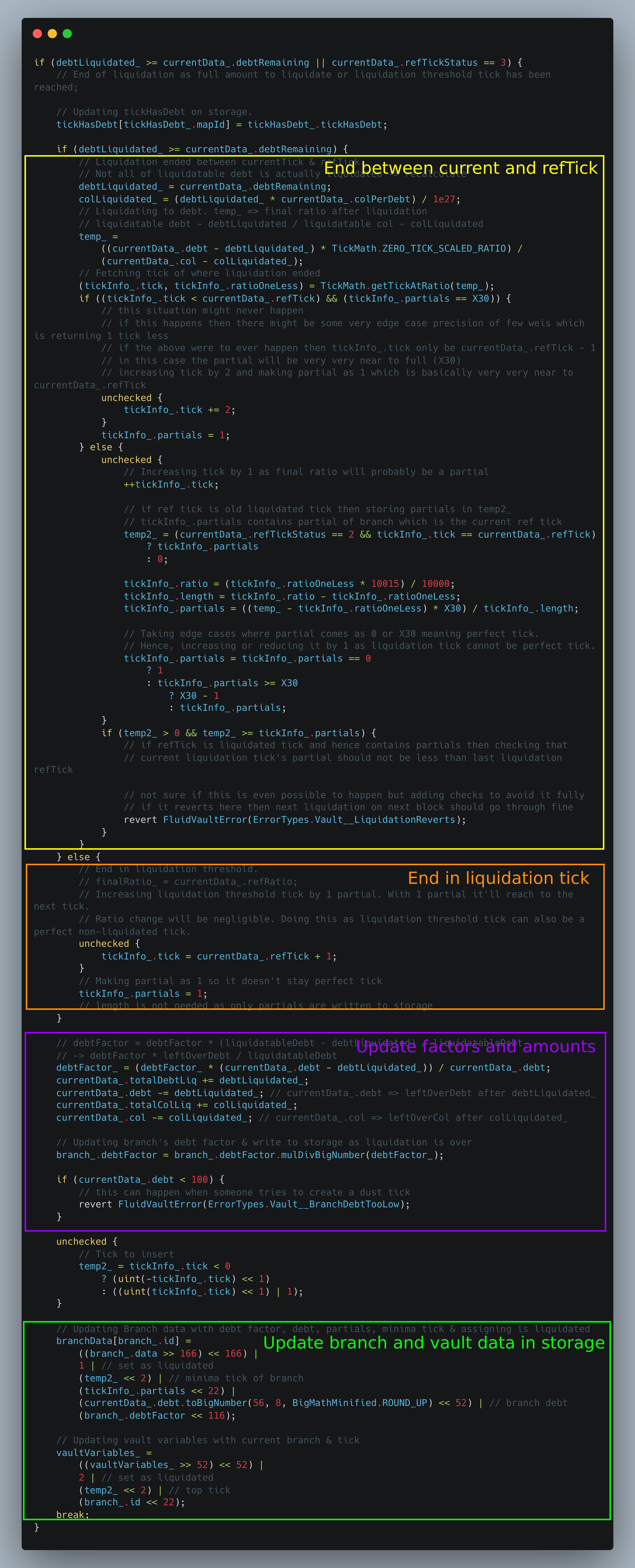
The only way we can enter this final loop state is if:
- either we are left with no debt from liquidator
- or we reached the liquidation tick
which can be validated by the outer if:
if (debtLiquidated_ >= currentData_.debtRemaining || currentData_.refTickStatus == 3) ...
So let’s analyze those 2 cases.
No debt remaining for liquidation
We wanted to reach the next reference tick, but we don’t have enough debt left from liquidator from previous liquidation iterations.
In that case, we calculate exact debt and collateral remaining and the exact ratio we ended up at:
debtLiquidated_ = currentData_.debtRemaining;
colLiquidated_ = (debtLiquidated_ * currentData_.colPerDebt) / 1e27;

// Liquidating to debt. temp_ => final ratio after liquidation
// liquidatable debt - debtLiquidated / liquidatable col - colLiquidated
temp_ =
    ((currentData_.debt - debtLiquidated_) * TickMath.ZERO_TICK_SCALED_RATIO) /
    (currentData_.col - colLiquidated_);
Once we have ratio, we can calculate the tick:
(tickInfo_.tick, tickInfo_.ratioOneLess) = TickMath.getTickAtRatio(temp_);
Note
Remember that
TickMath.getTickAtRatiorounds down!
Now we enter this first weird check:
if ((tickInfo_.tick < currentData_.refTick) && (tickInfo_.partials == X30)) ...
So what does this do?
We know when we set reference ratio and partials that partials of X30 were used if refTick was active perfect or liquidation tick.
So this check is really just a sanity check that should not trigger in normal circumstances, as newly ended tick will be above refTick in this case. But if this ever triggers, we want to move final tick just slightly above refTick:
// this situation might never happen
// if this happens then there might be some very edge case precision of few weis which is returning 1 tick less
// if the above were to ever happen then tickInfo_.tick only be currentData_.refTick - 1
// in this case the partial will be very very near to full (X30)
// increasing tick by 2 and making partial as 1 which is basically very very near to currentData_.refTick
unchecked {
    tickInfo_.tick += 2;
}
tickInfo_.partials = 1;
We can’t increase the tick by 1 and set partial close to ~X30, as that would not cross refTick. It would mean we increased the tick effectively by 0.9999...99.
But instead, if we increase it by 2 and set partial to 1, that would effectively mean we increased it by 1.0000...01, which would be just enough to cross refTick.
Good, now let’s see what happens when we don’t hit this rare edge case.
First of all, as TickMath.getTickAtRatio rounds down, we want to increase the calculated tick by 1:
// Increasing tick by 1 as final ratio will probably be a partial
++tickInfo_.tick;
Then, if reference tick is minima tick, we snapshot its partial value:
temp2_ = (currentData_.refTickStatus == 2 && tickInfo_.tick == currentData_.refTick)
    ? tickInfo_.partials
    : 0;
You will notice one thing here. We don’t just look if refTick is minima, but we also compare it against calculated tick.
Why?
Well, the main idea here is that both minima and calculated tick will have some partial. If they end in the same tick, we want to compare partials later to ensure that calculated tick is always strictly above refTick.
The next step is to calculate the partial for tick:
tickInfo_.ratio = (tickInfo_.ratioOneLess * 10015) / 10000;
tickInfo_.length = tickInfo_.ratio - tickInfo_.ratioOneLess;
tickInfo_.partials = ((temp_ - tickInfo_.ratioOneLess) * X30) / tickInfo_.length;
Then, we ensure that calculated partial won’t end up at perfect tick. We already talked about this before, but we don’t want final liquidation to end at perfect tick. Rather, every liquidation should end up at minima that will have some partial:
// Taking edge cases where partial comes as 0 or X30 meaning perfect tick.
// Hence, increasing or reducing it by 1 as liquidation tick cannot be perfect tick.
tickInfo_.partials = tickInfo_.partials == 0
    ? 1
    : tickInfo_.partials >= X30
        ? X30 - 1
        : tickInfo_.partials;
Finally, we use previously stored refTick partial (if it was minima tick) to compare it against current partial:
if (temp2_ > 0 && temp2_ >= tickInfo_.partials) {
    // if refTick is liquidated tick and hence contains partials then checking that
    // current liquidation tick's partial should not be less than last liquidation refTick
    // not sure if this is even possible to happen but adding checks to avoid it fully
    // if it reverts here then next liquidation on next block should go through fine
    revert FluidVaultError(ErrorTypes.Vault__LiquidationReverts);
}
So with this check, we want to guarantee that tick will be above refTick. They may have the same value, but partial of tick should be greater than refTick partial.
End in liquidation tick
The other case is straightforward. We know that we ended up at refTick, which is liquidation tick, and the only thing left to do is to ensure that this refTick won’t be perfect tick. Again, we do this by increasing it by 1 and setting the partial to 1, which was already discussed.
tickInfo_.tick = currentData_.refTick + 1;

// Making partial as 1 so it doesn't stay perfect tick
tickInfo_.partials = 1;
Update factors and amounts
Once we have final tick, we can repeat the steps we did during liquidation loops and update the factors with collateral and debt amounts. We won’t repeat the steps as logic is the same.
Update branch and vault data in storage
The final step would be to update branch and vault data.
We set current branch as liquidated, and we store previously calculated values:
- minima tick
- branch partials (which with
minimaTickwe ensured was aboverefTick) - leftover debt
- final debt factor
branchData[branch_.id] =
    ((branch_.data >> 166) << 166) |
    1 | // set as liquidated
    (temp2_ << 2) | // minima tick of branch
    (tickInfo_.partials << 22) |
    (currentData_.debt.toBigNumber(56, 8, BigMathMinified.ROUND_UP) << 52) | // branch debt
    (branch_.debtFactor << 116);
And for vault, we set the new topTick, label it as liquidated and set the current latest branch where liquidation ended.
vaultVariables_ =
    ((vaultVariables_ >> 52) << 52) |
    2 | // set as liquidated
    (temp2_ << 2) | // top tick
    (branch_.id << 22);
break;
Whoa, we finally finished the main liquidation loop, which marks our job 99% done! 🎉